Thursday, April 30, 2020
Response to "Why is Anglicanism a Gateway to (Roman) Catholicism?"
(This was my response on social media to the following article: Why is Anglicanism a Gateway to Catholicism? I adapted it slightly for the purpose of being put on this blog. I recommend you read the article first, then look at this response.)
Apparently I should be a Roman Catholic, yet those who know me well know very much I'll never be joining Rome unless they repent.
And I will say this: he claims that "The departures to the Roman Catholic Church are especially pronounced among the young, the highly educated, and those who came to Anglicanism as disaffected evangelicals." I find this problematic on a number of levels.
1) No citations given for such a claim, nothing beyond an assertion. Which is problematic when it's central to your entire argument. Also, he cites extensively in this article, so it's not in the least unreasonable to ask for such a citation.
2) I do not know a single person who's joined Rome from Anglicanism who fits all three, whether in real life or on social media. I know literally one in real life, through seminary, who was raised Anglican who became a Byzantine Papal Catholic. I know three or four others online (and I know literally thousands of people online). None of them fits all three criteria.
Also, while this doesn't speaks explicitly of ACNA conversions to Rome, I do find it important and interesting that, according to Pew research, Roman Catholicism in the US experiences the largest net loss in membership.
I'd like a citation for the Institutes being the most popular read at the time. And honestly I don't deny it, but I'd still like to see it cited rather than asserted.
The Institutes is, by the way, far too Catholic for many of the Reformed today. I myself have a copy of the Institutes, and I read it. There is a lot of good in it; I say that as a self-described Anglo-Catholic. Do I agree with everything? No. But if I lived at that time I would still have been reading it. To claim that it was popular is not to claim that it was adhered to 100%.
He treats "Protestant" and "Catholic" as mutually exclusive. That is not the case.
"The contrary view, that Anglicanism is historically a via media between Catholicism and Protestantism, has been so often debunked it only lives on in potted histories for Anglican rookies."
^^^The problem here is that, fundamentally, we are and have always considered ourselves to be Catholic. We confess that in the Creeds. So either we confess a known lie intentionally or we confess what we actually believe.
"Many of our fellow Christians find their beliefs distinguished and decisively rejected in the Thirty-Nine Articles, the Black Rubric, and the exhortations in the Communion service."
The Black Rubric was illegally inserted into the 1552 Book of Common Prayer, and is far too controversial to be simply tossed about as casually as that. The 1662 Rubric that took its place is better, while I still have issues with it.
His stuff on the mindset of Anglicanism being "the hallway" of the Mere Christianity House is, I think, accurate; Lewis himself explicitly states that the hallways are not the place to stay in. I don't know if Anglo-Catholics can be accused of doing that, though. There is a major difference between Catholicity (which is what every Anglo-Catholic I know of points to) and being non-denominational. For instance, as an Anglo-Catholic you must believe in the Real Presence of Christ in the Eucharist. If you hold to Anglicanism being the Hallway, then that isn't necessary. There are Christians who hold to a symbolic view. Rather, this Anglicanism as Hallway mentality sounds more like a least common denominator mentality.
His second point, I'm amening all of the way until his critique of the "extra offices" and ceremonies in the 2019 Prayer Book. He argues (or implies, at least) that Cranmer's "Of Ceremonies" argues against any additions of ceremonies or offices. I think that the second paragraph really demonstrates that is not the case, especially in the first sentence, "And although the keeping or omitting of a Ceremony, in itself considered, is but a small thing; yet the wilful and contemptuous transgression and breaking of a common order and discipline is no small offence before God, Let all things be done among you, saith Saint Paul, in a seemly and due order: The appointment of the which order pertaineth not to private men; therefore no many ought to take in hand, nor presume to appoint or alter and publick or common Order in Christ's Church, except he be lawfully called and authorized to do so."
As well, in the first paragraph, he argues that even superstitious ceremonies did not necessarily come from bad intentions, and that one could get back to them with their original intention.
Also, if we are going to claim that Calvin is a major influence upon Anglicanism, the fact is that Calvin did not see iconography as intrinsically evil, according to R.C. Sproul (who was, if you don't know, a Presbyterian), for example. Calvin's mindset, which is similarly seen here in Cranmer's "Of Ceremonies" is that the taking away of these certain Offices and Ceremonies has specifically to do with their cultural moment. The conclusion of this is most certainly that they can be reintroduced once we get further away from them. For instance, a smartphone is not bad. However, if I am addicted to it I might need to have mine taken away, at least until I can be healed of my addiction.
And I always find it interesting that, literally in Cranmer's own words, we find this warning, "For as those be taken away which were most abused, and did burden men's consciences without any cause; so the other that remain, are retained for a discipline and order, which (upon just cause) may be altered and changed, and therefore are not to be esteemed equal with God's Law." Later he writes, "And in these our doings we condemn no other Nations, nor prescribe any thing but to our own people only: For we think it convenient that every Country should use such Ceremonies as they shall think best to the setting forth of God's honour and glory, and to the reducing of the people to a most perfect and godly living, without error or superstition; and that they should put away other things, which from time to time they perceive to be most abused, as in men's ordinances it often chanceth diversely in divers countries."
So this is hardly a claim that the Reformation Ceremonies HAVE to be kept for all time; it would, in fact, be a gross error to claim such a thing. As well, "Of Ceremonies" would explicitly reject any judgment of the ACNA's practices, as the ACNA is not in England.
I'm glad he points to the error of the "Anglicanism as Hallway" mindset. I agree. That's not an Anglo-Catholic thing, though. Saying that we do not innovate on the Faith is not the same as saying we accept all innovations on the Faith. Now, that is a critique of the ACNA's, perhaps. It's certainly a critique I have with the new Prayer Book, as much as I like it. But it's not a critique of Anglo-Catholicism. Not in the least.
"Modern Anglicanism offers much of the ceremonial of Catholicism, but it can offer only a second-best. Constrained, however modestly, by its own history and the Articles, it cannot match the full range of Catholic ceremonial."
...Has he been to a Novus Ordo? I regularly have Roman friends of mine admit that Anglo-Catholics do liturgy better than Roman Catholics. We can surely match and exceed Novus Ordo masses, insofar as ceremonials are concerned. This is really just an odd claim.
"Why is it surprising, then, if they embrace a church that lays claim to precisely the same inheritance, but with a more perfect unity of its pre-Reformation ceremony and pre-Reformation doctrine?"
That's just historically not true, and embarrassingly so. There were multiple forms of the Latin Rite. And Rome's current doctrine is an absolute mess. Anglo-Catholicism, again, is not an "anything goes" form of Christianity; it's actually impossible to even envisage it as such, in my estimation. Even with the non-denominational "relationship not a religion" "doctrine divides" types, you can grasp a fundamental set of positions: opposes infant baptism, opposes any efficacy in the Sacraments, is charismatic, opposes liturgy, etc.
I need to make this into either an article or a YouTube video, now. (I did.)
Saturday, December 21, 2019
What It Means for an Anglican to Join Rome
*Note: throughout this article I use two terms in referring to the communion under the authority of the Bishop of Rome: Roman Catholicism and Romanism. I tend to use the term "Romanism" when speaking explicitly of the unique theological positions of Rome and those under her, which would differentiate her not only from Protestantism but from the various Eastern Communions as well. "Romanism" should not be considered a slur, any more than "Anglicanism" or "Lutheranism" should be. To claim that those under Papal authority are merely "Catholics" is to imply that they constitute the entirety of the Catholic Church. Romanists believe this, but those out from under her authority should not. As an Anglican, I consider myself fully Catholic and part of the One Holy Catholic and Apostolic Church, which I confess each Sunday at Mass in the words of the Nicene Creed.*
This week Bishop Gavin Ashendon finally confessed that he is leaving Anglicanism and joining Rome, this Fourth Sunday of Advent, 2019.
Anyone who knows Bishop Gavin knew this was a long time coming; his wife has already joined Rome, and he always speaks well of Roman Catholicism and has hinted about joining for quite a while. I do not say this to be flippant of him or his decision; on the contrary, I have great respect for the Bishop. However, as an Anglican who would align himself with the Anglo-Catholic end of the spectrum, I do have a few concerns with both his reasoning for this decision and its ramifications.
First, I will give a direct response to Bishop Gavin (he wrote, here, an article explaining some of his reasoning for joining Rome), dealing with the points he brings up in what brought him to his decision. I will then give a general assessment of what it means for an Anglican, especially of the Anglo-Catholic Tradition, to leave Anglicanism and join Rome.
Response to Bishop Gavin
The Bishop starts with writing about his experience smuggling Bibles and seminary books into communist countries during the 80's for Roman Catholic seminaries. He says, "my experiences of the underground (Roman) Catholic Church in Czechoslovakia would act as a catalyst and an example to bring me to my true spiritual home." He then talks about how Western society is being taken over by cultural Marxism, how he had seen it budding first in progressive universities (including one in which he taught), and how Anglicanism was being swallowed whole, before his very eyes, into this Marxist black pit.
Of course, the immediate thought is, "Wait...are you going to tell me that Rome is somehow blocked from this Marxist attack?" The Bishop is no fool, of course. He rightly states, "Some friends have warned me that I will not find the grass any greener on the (Roman) Catholic side of the fence. Of course I won't. The (Roman) Catholic Church faces exactly the same spiritual, cultural and political crisis. But the pilgrimage is not about comfort, it is about truth and integrity."
The Bishop's admission here that Rome is no better off is an important one, and demonstrates that, so far, he has no delusions of theological harmony within the halls of Romanism. From here, Bishop Gavin delves into three reasons he decided to join Rome.
1) Our Lady at Garabandal
Marian apparitions (alleged or otherwise) are not my expertise. I had to look up this particular one that the Bishop mentioned. After seeing video footage of the children experiencing this alleged apparition (and I note that Bishop Gavin points out that this one has never been confirmed by Rome), the Bishop started a study of Marian Apparitions throughout history. This eventually led to a devotion to praying the Rosary, especially during dark times in Bishop Gavin's life.
The concern I have here is twofold: first, I do not know how any of this leads to Rome. I know many Anglican churches that not only have members who pray the Rosary, they have classes as well. I myself pray the Rosary, especially when I am with any Roman Catholic family members. There are Lutherans who pray the Rosary as well. And of course, Eastern Orthodox could never be accused of having a low view of the Blessed Virgin. How does this lead to Rome?
The second is a more serious problem: that of theological methodology. The viewing of an experience was what started this intellectual endeavor of the Bishop. From there, Bishop Gavin moves to looking at Marian Apparitions (alleged or otherwise). This leads to some conclusion that Rome...is the one True Church? No explanation of how is given, but worse: no Scriptural citation was given that would even suggest this way of determining one's ecclesiology. Scripture is never cited in this, or in fact in the entire article. Even if one holds to the Magisterium, the reasons given here had nothing to do with it. In fact, as already noted, the Magisterium does not formally recognize Our Lady at Garabandal as an authentic visitation of the Blessed Virgin.
2) Eucharistic Miracles
Bishop Gavin moves on to Eucharistic miracles. He states that no Anglican Eucharistic miracles have ever been witnessed, and cites that as something that carries "obvious implications".
The implications are not obvious to me. There are many possible answers; one of them being, "There are Eucharistic miracles." My priest from my sending parish tells, in his class on the Eucharist, two stories about the power he's witnessed in the Blessed Sacrament. The first one is here: He speaks of how, in his 30's, he was in a deeply depressive state. He was commanded by a priest friend of his, in the Episcopal Church, to receive Communion for his own healing. My priest did so; literally coming in late on purpose, then leaving as soon as he received. Over the months he was healed of his state.
This is a Eucharistic miracle; one which is what the Eucharist is actually for. The purpose of the Eucharist is not to bleed and thus be hidden away in a monstrance and never to be consumed. I would rather one single life be changed by the Eucharist, especially concerning how much that life has been used by God to bless others, than one thousand visibly bleeding Hosts appear before me.
Another story he tells is here: in it he speaks about a little girl, around 4-6 years old, who went up to receive; she kept standing on the kneeler, leaning over the rail to see what was in the ciborium my priest was holding. He let her look inside, and she then turned to her mother and said, "Mommy, I just saw Jesus!" Grinning, my priest said to the mother, "I like your daughter's theology."
The "obvious implications" that Bishop Gavin mentioned are not so obvious when you take these and others into account. Aside from these and other stories (ones which have not been made public by those who witnessed it, so I will not make them public here), my own experience with the Eucharist has been one of healing, specifically of depression while being given a sense of purpose. What I speak of is not rare within Anglicanism, at least insofar as I've seen. True, I know of no bleeding Host accounts within Anglicanism (again, not that I have looked for any; I consider them unimportant), but I know countless healing stories of the Eucharist within Anglicanism; this is actually what the Eucharist is for. Is Bishop Gavin unaware of the healing power of the Eucharist being present within Anglicanism? If so, I would not wish to guess why. If he is, why is a bleeding Host more important and better evidence than the Medicine working would be?
3) The Magisterium
The Magisterium is, according to Bishop Gavin, a unifying force for Romanism that guards against heresy. I admit that this claim baffles me. Bishop Gavin knows about the Amazonian Synod and the heretical statements (on almost any standard) of Pope Francis. Bishop Gavin knows about the literal pachamama idols used during worship in the Amazonian Synod. Not only used, but when a devout Roman Catholic took them away and dumped the idols into the Tiber, Pope Francis had them retrieved and made an announcement that they were found, calling them "pachamama" in his very speech. They are, literally, idols; not representations of the Blessed Virgin, but actual pagan, non-Christian, idols.
German Roman Catholic Bishops recently came out saying that homosexuality is a "normal" part of human sexuality; I could find no response from Papacy, and certainly nothing to the level of excommunication or even a threat of one.
Even Bishop Gavin admits that the grass isn't "greener" in Rome, as I quoted above. Why does this argument stand for him? Because it is the assurance, it seems, that no matter how bad it gets God will protect the Papacy from falling formally into heresy.
This argument assumes that Rome and the Papacy have not already done so, and multiple times. From the historical problems facing Papal Infallibility such as the heretic (and named as such by an Ecumenical Council) Pope Honorius, to the elevation of the Immaculate Conception as de fide, to Cardinal Newman's rather contrived argument of doctrinal development (you can fit literally any theological system into history through doctrinal development), I find the evidence to the contrary rather convincing. Rome is, currently, heretical. Even under Pope Benedict XVI. Even under Pope St. John Paul II. Going back to the Council of Trent, and further back beyond that, Rome has committed herself to many a heresy.
The Major Problem of Swimming the Tiber
There are a few major issues with an Anglican swimming the Tiber to join Rome. We can talk about Justification, Papal Supremacy, and other doctrinal positions of significant importance. The one doctrinal position I wish to bring up might seem minor, but it has serious consequences for the Anglican who wishes to join Rome: that is the 1896 Papal Bull Apostolicae Curae.
I will not delve into an entire account of Apostolicae Curae; rather I will link you to a paper I did last year on the topic, defending Holy Orders within Anglicanism from the arguments made by Rome in that Papal Bull. If you are not familiar with the topic of Holy Orders, especially as it relates to Apostolicae Curae, I encourage you to read the paper.
I consider Apostolicae Curae to be one of the most poorly-made arguments against Holy Orders within Anglicanism that could possibly be published. Nevertheless, Rome in the 1990's issued an Apostolic Letter, Ad Tuendem Fidem, in which then-Cardinal Ratzinger had attached in a doctrinal commentary to the letter the claim that Apostolicae Curae was one example where certain proclamations made by the Papacy were "unquestionable" (though not necessarily infallible).
Here lies to problem: to become a Roman Catholic, you must submit to the teachings of Rome. This addendum to the Ad Tuendem Fidem was never rescinded. Furthermore, in Roman Catholicism the standard (and I only know of one exception: that of Fr. John Jay Hughes) is unconditonal re-Ordination and re-Confirmation. What this means is that, when you go from Anglicanism to Romanism, you must implicitly affirm that you have not sacramentally received the Sacrament of Confirmation, the Sacrament of Holy Orders, or even the Sacrament of the Body and Blood of Christ. One must, in other words, in a way deny Christ.
For Anglicans, especially Anglicans of the Anglo-Catholic Tradition, this should be a serious issue. If you have not thought out your theology on the Sacraments, if you have not thoroughly considered the issues of Apostolicae Curae and their implications, you are in no state to leave Anglicanism and join Rome. You do need to consider what it is you are rejecting when you go from Anglicanism to Romanism. This is not merely a jurisdictional change, like going from Anglicanism to Old Catholicism or Anglicanism to Lutheranism. This is a unique relationship Anglicanism has with Romanism. Rome has made a specific, theological argument against the validity of our Holy Orders and thus has ultimately claimed that we have no sacramental assurance of receiving the Body and Blood of Christ in the Eucharist. They have not issued such a formal declaration against Lutherans, and in fact have said the opposite about communions such as Old Catholics, Eastern Orthodox, Oriental Orthodox, etc.
I have many issues with Rome; serious issues. I consider this to be one of the top ones. Apostolicae Curae only convinces me that Rome in the late 1800's was willing to use her assumed ecclesiastical authority to play ecclesiastically political games, to the detriment of theology. The arguments are, simply put, really bad (again, see my paper). But now that they cannot be questioned by the Roman faithful, in order to join Rome I would have to submit to the belief that not only are Holy Orders within Anglicanism "absolutely null and utterly void", as Apostolicae Curae says, but as a consequence of that believe that Jesus' Presence in the Eucharist I've received as an Anglican for seven years is "absolutely null and utterly void". I cannot, in good conscience, reject my Savior's Presence in the Sacrament that He has graced me with. This is the primary reason that I can never join Rome, and should be a most serious impediment to other Anglicans as well.
The Barely Protestant blog is run by Rev. A. James Gadomski, a Deacon within the Anglican Church in North America. To contact him, please e-mail at barelyprotestant@gmail.com. As well, there is a Facebook page here.
This week Bishop Gavin Ashendon finally confessed that he is leaving Anglicanism and joining Rome, this Fourth Sunday of Advent, 2019.
Anyone who knows Bishop Gavin knew this was a long time coming; his wife has already joined Rome, and he always speaks well of Roman Catholicism and has hinted about joining for quite a while. I do not say this to be flippant of him or his decision; on the contrary, I have great respect for the Bishop. However, as an Anglican who would align himself with the Anglo-Catholic end of the spectrum, I do have a few concerns with both his reasoning for this decision and its ramifications.
First, I will give a direct response to Bishop Gavin (he wrote, here, an article explaining some of his reasoning for joining Rome), dealing with the points he brings up in what brought him to his decision. I will then give a general assessment of what it means for an Anglican, especially of the Anglo-Catholic Tradition, to leave Anglicanism and join Rome.
Response to Bishop Gavin
The Bishop starts with writing about his experience smuggling Bibles and seminary books into communist countries during the 80's for Roman Catholic seminaries. He says, "my experiences of the underground (Roman) Catholic Church in Czechoslovakia would act as a catalyst and an example to bring me to my true spiritual home." He then talks about how Western society is being taken over by cultural Marxism, how he had seen it budding first in progressive universities (including one in which he taught), and how Anglicanism was being swallowed whole, before his very eyes, into this Marxist black pit.
Of course, the immediate thought is, "Wait...are you going to tell me that Rome is somehow blocked from this Marxist attack?" The Bishop is no fool, of course. He rightly states, "Some friends have warned me that I will not find the grass any greener on the (Roman) Catholic side of the fence. Of course I won't. The (Roman) Catholic Church faces exactly the same spiritual, cultural and political crisis. But the pilgrimage is not about comfort, it is about truth and integrity."
The Bishop's admission here that Rome is no better off is an important one, and demonstrates that, so far, he has no delusions of theological harmony within the halls of Romanism. From here, Bishop Gavin delves into three reasons he decided to join Rome.
1) Our Lady at Garabandal
Marian apparitions (alleged or otherwise) are not my expertise. I had to look up this particular one that the Bishop mentioned. After seeing video footage of the children experiencing this alleged apparition (and I note that Bishop Gavin points out that this one has never been confirmed by Rome), the Bishop started a study of Marian Apparitions throughout history. This eventually led to a devotion to praying the Rosary, especially during dark times in Bishop Gavin's life.
The concern I have here is twofold: first, I do not know how any of this leads to Rome. I know many Anglican churches that not only have members who pray the Rosary, they have classes as well. I myself pray the Rosary, especially when I am with any Roman Catholic family members. There are Lutherans who pray the Rosary as well. And of course, Eastern Orthodox could never be accused of having a low view of the Blessed Virgin. How does this lead to Rome?
The second is a more serious problem: that of theological methodology. The viewing of an experience was what started this intellectual endeavor of the Bishop. From there, Bishop Gavin moves to looking at Marian Apparitions (alleged or otherwise). This leads to some conclusion that Rome...is the one True Church? No explanation of how is given, but worse: no Scriptural citation was given that would even suggest this way of determining one's ecclesiology. Scripture is never cited in this, or in fact in the entire article. Even if one holds to the Magisterium, the reasons given here had nothing to do with it. In fact, as already noted, the Magisterium does not formally recognize Our Lady at Garabandal as an authentic visitation of the Blessed Virgin.
2) Eucharistic Miracles
Bishop Gavin moves on to Eucharistic miracles. He states that no Anglican Eucharistic miracles have ever been witnessed, and cites that as something that carries "obvious implications".
The implications are not obvious to me. There are many possible answers; one of them being, "There are Eucharistic miracles." My priest from my sending parish tells, in his class on the Eucharist, two stories about the power he's witnessed in the Blessed Sacrament. The first one is here: He speaks of how, in his 30's, he was in a deeply depressive state. He was commanded by a priest friend of his, in the Episcopal Church, to receive Communion for his own healing. My priest did so; literally coming in late on purpose, then leaving as soon as he received. Over the months he was healed of his state.
This is a Eucharistic miracle; one which is what the Eucharist is actually for. The purpose of the Eucharist is not to bleed and thus be hidden away in a monstrance and never to be consumed. I would rather one single life be changed by the Eucharist, especially concerning how much that life has been used by God to bless others, than one thousand visibly bleeding Hosts appear before me.
Another story he tells is here: in it he speaks about a little girl, around 4-6 years old, who went up to receive; she kept standing on the kneeler, leaning over the rail to see what was in the ciborium my priest was holding. He let her look inside, and she then turned to her mother and said, "Mommy, I just saw Jesus!" Grinning, my priest said to the mother, "I like your daughter's theology."
The "obvious implications" that Bishop Gavin mentioned are not so obvious when you take these and others into account. Aside from these and other stories (ones which have not been made public by those who witnessed it, so I will not make them public here), my own experience with the Eucharist has been one of healing, specifically of depression while being given a sense of purpose. What I speak of is not rare within Anglicanism, at least insofar as I've seen. True, I know of no bleeding Host accounts within Anglicanism (again, not that I have looked for any; I consider them unimportant), but I know countless healing stories of the Eucharist within Anglicanism; this is actually what the Eucharist is for. Is Bishop Gavin unaware of the healing power of the Eucharist being present within Anglicanism? If so, I would not wish to guess why. If he is, why is a bleeding Host more important and better evidence than the Medicine working would be?
3) The Magisterium
The Magisterium is, according to Bishop Gavin, a unifying force for Romanism that guards against heresy. I admit that this claim baffles me. Bishop Gavin knows about the Amazonian Synod and the heretical statements (on almost any standard) of Pope Francis. Bishop Gavin knows about the literal pachamama idols used during worship in the Amazonian Synod. Not only used, but when a devout Roman Catholic took them away and dumped the idols into the Tiber, Pope Francis had them retrieved and made an announcement that they were found, calling them "pachamama" in his very speech. They are, literally, idols; not representations of the Blessed Virgin, but actual pagan, non-Christian, idols.
German Roman Catholic Bishops recently came out saying that homosexuality is a "normal" part of human sexuality; I could find no response from Papacy, and certainly nothing to the level of excommunication or even a threat of one.
Even Bishop Gavin admits that the grass isn't "greener" in Rome, as I quoted above. Why does this argument stand for him? Because it is the assurance, it seems, that no matter how bad it gets God will protect the Papacy from falling formally into heresy.
This argument assumes that Rome and the Papacy have not already done so, and multiple times. From the historical problems facing Papal Infallibility such as the heretic (and named as such by an Ecumenical Council) Pope Honorius, to the elevation of the Immaculate Conception as de fide, to Cardinal Newman's rather contrived argument of doctrinal development (you can fit literally any theological system into history through doctrinal development), I find the evidence to the contrary rather convincing. Rome is, currently, heretical. Even under Pope Benedict XVI. Even under Pope St. John Paul II. Going back to the Council of Trent, and further back beyond that, Rome has committed herself to many a heresy.
The Major Problem of Swimming the Tiber
There are a few major issues with an Anglican swimming the Tiber to join Rome. We can talk about Justification, Papal Supremacy, and other doctrinal positions of significant importance. The one doctrinal position I wish to bring up might seem minor, but it has serious consequences for the Anglican who wishes to join Rome: that is the 1896 Papal Bull Apostolicae Curae.
I will not delve into an entire account of Apostolicae Curae; rather I will link you to a paper I did last year on the topic, defending Holy Orders within Anglicanism from the arguments made by Rome in that Papal Bull. If you are not familiar with the topic of Holy Orders, especially as it relates to Apostolicae Curae, I encourage you to read the paper.
I consider Apostolicae Curae to be one of the most poorly-made arguments against Holy Orders within Anglicanism that could possibly be published. Nevertheless, Rome in the 1990's issued an Apostolic Letter, Ad Tuendem Fidem, in which then-Cardinal Ratzinger had attached in a doctrinal commentary to the letter the claim that Apostolicae Curae was one example where certain proclamations made by the Papacy were "unquestionable" (though not necessarily infallible).
Here lies to problem: to become a Roman Catholic, you must submit to the teachings of Rome. This addendum to the Ad Tuendem Fidem was never rescinded. Furthermore, in Roman Catholicism the standard (and I only know of one exception: that of Fr. John Jay Hughes) is unconditonal re-Ordination and re-Confirmation. What this means is that, when you go from Anglicanism to Romanism, you must implicitly affirm that you have not sacramentally received the Sacrament of Confirmation, the Sacrament of Holy Orders, or even the Sacrament of the Body and Blood of Christ. One must, in other words, in a way deny Christ.
For Anglicans, especially Anglicans of the Anglo-Catholic Tradition, this should be a serious issue. If you have not thought out your theology on the Sacraments, if you have not thoroughly considered the issues of Apostolicae Curae and their implications, you are in no state to leave Anglicanism and join Rome. You do need to consider what it is you are rejecting when you go from Anglicanism to Romanism. This is not merely a jurisdictional change, like going from Anglicanism to Old Catholicism or Anglicanism to Lutheranism. This is a unique relationship Anglicanism has with Romanism. Rome has made a specific, theological argument against the validity of our Holy Orders and thus has ultimately claimed that we have no sacramental assurance of receiving the Body and Blood of Christ in the Eucharist. They have not issued such a formal declaration against Lutherans, and in fact have said the opposite about communions such as Old Catholics, Eastern Orthodox, Oriental Orthodox, etc.
I have many issues with Rome; serious issues. I consider this to be one of the top ones. Apostolicae Curae only convinces me that Rome in the late 1800's was willing to use her assumed ecclesiastical authority to play ecclesiastically political games, to the detriment of theology. The arguments are, simply put, really bad (again, see my paper). But now that they cannot be questioned by the Roman faithful, in order to join Rome I would have to submit to the belief that not only are Holy Orders within Anglicanism "absolutely null and utterly void", as Apostolicae Curae says, but as a consequence of that believe that Jesus' Presence in the Eucharist I've received as an Anglican for seven years is "absolutely null and utterly void". I cannot, in good conscience, reject my Savior's Presence in the Sacrament that He has graced me with. This is the primary reason that I can never join Rome, and should be a most serious impediment to other Anglicans as well.
The Barely Protestant blog is run by Rev. A. James Gadomski, a Deacon within the Anglican Church in North America. To contact him, please e-mail at barelyprotestant@gmail.com. As well, there is a Facebook page here.
Tuesday, August 20, 2019
Joshua Harris and Marty Sampson: When Christian Celebrities Question the Faith
Harris' book was just before my time; my teen years were largely in the 2000's. However, I do recall my older sister reading the book in the 90's. Curious, I would read passages in it whenever I found the book in the living room or wherever else she placed it. My ten year old mind didn't remember much about it other than this: apparently, if you wait to have sex until marriage you'll have this amazing wife, an amazing sex life, and wonderful children. That thought remained in the back of my mind when I finally started noticing, um, girls in my teens. I'd have probably never consciously articulated such a mindset, but looking back I know that the only reasons I remained a virgin were fear of STDs/teen-pregnancy and this desire to have a really great sex-life/marriage/kids.
I hope I don't have to tell you that that is a lie on par with The Prosperity (False) Gospel; in fact, all it is is a sex-centric version of that heresy. That has already been said by more than a few people, so if you're interested in understanding more about that I recommend these links: an article by Katelyn Beaty in Religion News Service, and another one by Emily Hall in Christianity.com. The point is that Harris, who was only 21 at the time he wrote that book, was shot to stardom in Evangelical circles while preaching a gospel of sexual prosperity summed up in this way: follow these rules on sex and God will give you your sexual dream.
Turn now to Marty Sampson of Hillsong. I don't know much about Mr. Sampson, and the little more I know about Hillsong I greatly dislike. A casual glance at the search engine results of his name shows that he's written also for Delirious? and other contemporary worship-style bands.
Sampson posted on Instagram that he was turning away from the Faith, though he has since clarified that he hasn't left it entirely yet (the Instagram post has since been deleted; above is a screenshot of it). I had mentioned that I greatly dislike Hillsong; to me it represents pretty much everything that is awful about contemporary Christian music, both musically and lyrically. What frustrates me about Sampson leaning towards leaving the Faith is not so much the fact that he is (although that is always sad), but the *reasons* he gave for it. Let's look at his words in the initial post:
"how many preachers fall? Many. No one talks about it. How many miracles happen. Not many. No one talks about it. Why is the Bible full of contradictions? No one talks about it. How can God be love yet send four billion people to a place, all coz they don’t believe? No one talks about it. Christians can be the most judgmental people on the planet - they can also be some of the most beautiful and loving people...but it’s not for me.”
There is no shame in asking these questions, no matter what age you are
The problem with this IG post is, bluntly put, how absolutely ignorant it is. Not in the questions at all--one of the best ways to learn is by asking questions--but in the claim that "no one" is talking about these things. Allowing for hyperbole, (almost) no one is talking about falling preachers, the theology of miracles, alleged and apparent contradictions in Scripture, theodicy, etc.? Forget reading books, has he ever even done an online search with those questions and read or watched any pro-Christian results? The question-asking, again, is not the problem: the apparent lack of desire to find answers is what is so frustrating.
Has Sampson ever heard of Christian Apologetics? Has he ever read a single book on Systematic Theology, or even a single book by a Christian Theologian? Not Bill Johnson or Brian Houston, but actually academic Christian Theologians? I don't ask these questions with a desire to belittle; I genuinely am curious. Sampson has recently posted about realizing that he doesn't have to take the Genesis 1 and 2 accounts of Creation as scientifically literal, and how that apparently seemed liberating to him. Again, he is only now discovering this?
***Edit: I realized, shortly after posting this, that some people reading this article might not be aware of resources that can help with these questions. Here is a list of great books, websites, and podcasts on a number of hard issues to answer within Christianity:
Books:
Mere Christianity, by C.S. Lewis
On Guard: Defending Your Faith with Reason and Precision, by William Lane Craig
Tactics: a Plan for Discussing Your Christian Convictions, by Greg Koukl
I Don't Have Enough Faith to Be an Atheist, by Frank Turek and Norm Geisler
Inference to the One True God: Why I Believe in Jesus Instead of Other Gods, by Evan Minton
Websites:
Reasonable Faith
Cross Examined
Paul Copan's Website
Podcasts:
Unbelievable?
Religious Nut and Hellbound Sinner (my former podcast)
Cerebral Faith
This is just a small list of resources; websites like Reasonable Faith have podcast and YouTube channels as well.***
***Edit: I realized, shortly after posting this, that some people reading this article might not be aware of resources that can help with these questions. Here is a list of great books, websites, and podcasts on a number of hard issues to answer within Christianity:
Books:
Mere Christianity, by C.S. Lewis
On Guard: Defending Your Faith with Reason and Precision, by William Lane Craig
Tactics: a Plan for Discussing Your Christian Convictions, by Greg Koukl
I Don't Have Enough Faith to Be an Atheist, by Frank Turek and Norm Geisler
Inference to the One True God: Why I Believe in Jesus Instead of Other Gods, by Evan Minton
Websites:
Reasonable Faith
Cross Examined
Paul Copan's Website
Podcasts:
Unbelievable?
Religious Nut and Hellbound Sinner (my former podcast)
Cerebral Faith
This is just a small list of resources; websites like Reasonable Faith have podcast and YouTube channels as well.***
It's not simply that he's struggling with these questions as a forty year old; plenty of people that age and older have finally started to deal with tough questions in the Christian Faith. I want to make this understood, which is why I'm repeating it: there is no shame in asking these questions, no matter what age you are. The problem is that he's literally been a Christian leader to many for decades. He's been writing professionally for Evangelical worship since the 90's.
Which brings me to the other problem that this IG post represents: the fact that it's not only very ignorant, but very true. "No one" (hyperbole, again, recognized) is caring about these questions...in the megachurch "relationship not religion" pop-concert-followed-by-a-TED-Talk Sunday gathering that calls itself Evangelical Christianity today. In much of this group of Christianity, which is quickly growing by the way (and that's not a good thing), doctrine doesn't matter. It's all about the entertainment. The pastor comes in with the flip-flops and Hawaiian tee, gives a moralizing speech with emotionally-driven music--made specifically to be entertaining and with almost no theological depth to it--on either side of his (or her) half-hour talk, and the people call it a day and live the entire week exactly the same way they did previously.
That is what passes for popular Christianity today in the West: don't worry about doctrine, because it divides. Instead, teach about being good people, and that God loves everyone. This has been termed Moralistic Therapeutic Deism. We've known about this development within Christendom in the West for about fifteen years, specifically amongst teens in the early 2000's; in other words, today's young leaders. It hasn't been ignored; worse, it's been embraced. Moralistic Therapeutic Deism is identified as having five tenets of faith:
- A God exists who created and ordered the world and who watches over human life on earth.
- God wants people to be good, nice, and fair to each other, as taught in the Bible and by most religions.
- The central goal of life is to be happy and to feel good about oneself.
- God does not need to be particularly involved in one's life except when God is needed to resolve a problem.
- Good people go to heaven when they die.
This isn't even a bare-bones understanding of Christianity. This is not Christianity at all; this is straight up pluralism. Attaching the word "Jesus" to this does nothing but add food color to a watered-down spirituality. It is like adding dye to a glass of water and declaring you've turned water into wine.
Conclusion
This is why we need to care about preaching the Gospel, teaching people, and discipling them in the Church. It is not enough to give a free concert and a motivational speech once a week, wipe the dust off our hands, then call it a day. A faith that does not have reasons for its moral positions, or a source, is an unrooted faith. When the source of our faith is "the god within" we end up making ourselves our own god, chasing our own tails for every wind of doctrine and piety we sniff.
We only encourage such action when our religion (and yes, "spiritual but not religious" is a religion; make no doubt about that) primarily teaches us by coddling to our entertainment needs. Whether those needs are in a sexual pleasure ("Be celibate until marriage and you'll have freakin' awesome sex!") or other social pleasures ("Don't think about the hard questions! Just enjoy this pop music that has no spiritual depth and listen to these practical life lessons that don't challenge you to grow in the Faith, while you sit in a comfortable seat with your casual clothes and Christian coffee latte, posting a selfie n the midst of service."), our churches have been training us to be catechized, or taught, by self-indulgence. By doing so we make ourselves the center of the universe, the Canon of our faith. And we do so blasphemously when we rename our personal desires "The Holy Spirit".
Tuesday, September 18, 2018
Dear Evangelicals...
Stop.
Stop telling your friend that she doesn't have enough faith in Jesus because she's taking her medication prescribed by her doctor.
Stop telling your kids that it's wrong to ask hard questions about the Faith.
Stop pretending that you're super spiritual for refusing to study your own Faith. A simple faith is not the same as an ignorant faith.
Stop worshiping the flag of the United States.
Stop pretending that you're non-denominational. We all know what that means: Baptist with some charismatic leanings, and brimming with Puritan moral standards.
Stop treating Jesus like some high school letterman heartthrob who's picture is in your locker with a red lipstick stain on it.
Stop pretending to hate the divisions within Christianity when you're continuing the mindset that further divides Christianity each and every generation: namely, the idea that everyone has equal ability to interpret Scripture and deriving new theology from these interpretations is totally "not a problem".
Stop telling people that they don't need to earn God's love, when you constantly question the salvation of everyone who has a bad day or struggles with sin.
Stop writing songs that sound like a creepy high school boy is stalking a girl:
"In the secret, in the quiet place
In the stillness you are there.
In the secret, in the quiet hour I wait,
Only for you,'cause I want to know you more;
I want to know you,
I want to hear your voice
I want to know you more.
I want to touch you,
I want to see your face
I want to know you more."
Stop. Please stop. You've whittled down the Faith that has turned the entire course of the history of humanity into a bad 80's teen movie. You've turned the worship that has shaped untold millions into a teeny-bopper concert with a TED Talk. You've watered down our Lord and Savior Jesus Christ, the One Who will return with a flaming sword coming out of His Mouth into a hunky boy who's head-over-heels for you.
We will have to answer for how we present Jesus to the world. We will have to give an account for each and every action we take for the Gospel. Let us never forget that.
Stop telling your friend that she doesn't have enough faith in Jesus because she's taking her medication prescribed by her doctor.
Stop telling your kids that it's wrong to ask hard questions about the Faith.
Stop pretending that you're super spiritual for refusing to study your own Faith. A simple faith is not the same as an ignorant faith.
Stop worshiping the flag of the United States.
Stop pretending that you're non-denominational. We all know what that means: Baptist with some charismatic leanings, and brimming with Puritan moral standards.
Stop treating Jesus like some high school letterman heartthrob who's picture is in your locker with a red lipstick stain on it.
Stop pretending to hate the divisions within Christianity when you're continuing the mindset that further divides Christianity each and every generation: namely, the idea that everyone has equal ability to interpret Scripture and deriving new theology from these interpretations is totally "not a problem".
Stop telling people that they don't need to earn God's love, when you constantly question the salvation of everyone who has a bad day or struggles with sin.
Stop writing songs that sound like a creepy high school boy is stalking a girl:
"In the secret, in the quiet place
In the stillness you are there.
In the secret, in the quiet hour I wait,
Only for you,'cause I want to know you more;
I want to know you,
I want to hear your voice
I want to know you more.
I want to touch you,
I want to see your face
I want to know you more."
Stop. Please stop. You've whittled down the Faith that has turned the entire course of the history of humanity into a bad 80's teen movie. You've turned the worship that has shaped untold millions into a teeny-bopper concert with a TED Talk. You've watered down our Lord and Savior Jesus Christ, the One Who will return with a flaming sword coming out of His Mouth into a hunky boy who's head-over-heels for you.
We've turned Jesus
Into a 2nd Rate Brad Pitt
We will have to answer for how we present Jesus to the world. We will have to give an account for each and every action we take for the Gospel. Let us never forget that.
Saturday, July 7, 2018
Transcript of My FIRST SERMON
I was able to give a sermon on July 1st, 2018, at St. Peter's Anglican Cathedral. Unfortunately, there were problems with the recording; because of this, I decided to simply have the homily reproduced in text:
I hope you’re not hungry or tired, because my sermon is titled, “One Hundred and Twenty Seven Ways We Can Love our Neighbor”.
No, I’m kidding, but we are going to talk about Love today, a subject which we as a society know almost nothing about. Which is sad, because we talk about love ALL of the time; it is the most common subject of the most popular songs. It is the subject in some form of almost every movie. It is even in our advertising. We hear about newfound “love” or lost “love” or breaking up with one you “love”. But...are they really talking about love?
I mean, what is love? (*softly sings "Baby don't hurt me"*)
This problem is not only found within the secular society today; it is among self-professing Christians as well. I think we as the People of God do not always know what love is, exactly, for two reasons. The first one has been touched upon: we have been fed this understanding of love in which it is little more than a good feeling we receive from someone else. If that is the case, love is really only that feeling. If love is a feeling that we receive from thinking about or being with someone, then love is a commodity to be bought and sold, like anything else in the marketplace.
I think that this mindset causes the second reason we don’t know what love is, even as Christians: when the understanding of love becomes skewed, people follow that understanding, and those people become our examples of love. This can happen on the societal level: From horribly cheesy romantic comedies, to Disney movies teaching us that you can find “the one” after a three day adventure involving a magic carpet ride.
It can also be found on the personal level. From abusive fathers to neglectful mothers. From friends telling you that they care, only to never be found when the days are dark, to spouses walking out the door never to be seen again. All of these examples, and so many more, are bad example after bad example of love. They’re counterfeit love.
This is perhaps why my generation is so afraid of commitment; if half the marriages are ending up in divorce, why marry? Just live with the person, and when the infatuation and benefits end, leave; it’s cheaper that way. After all, love is only a feeling. When that feeling is no longer there, why continue with a charade?
This is why we need to get our understanding of love from God Himself, Who has revealed in Scripture what love is and how it works.
I want to look at three levels of love. Each of these levels goes deeper into what it means to love.
Love will have inconvenience.
More than that, love will havel dedication.
And finally, love will have self-sacrifice.
Inconvenience. Dedication. Self-sacrifice.
In the Old Testament reading for today (Deuteronomy 15:7-11), we see a command from God concerning what is known as the “year of release”.
You see, at this time, God had made in the Torah a law that debts were to be forgiven, among other things, every seven years...This sounds like a law that *cough* many of my fellow college and graduate students wouldn’t mind seeing on the books here in the US. Please write your representatives. It was part of a seven year Sabbath, a release from what binds us down.
So it would make sense, under the law of the ancient Israelites, to not give loans out to people when that seventh year was swinging around. Of course that makes sense! Until...you get to the reading today in Deuteronomy.
“Take heed lest there be a base thought in your heart, and you say, ‘The seventh year, the year of release is near,’ and your eye be hostile to your poor brother, and you give him nothing”. Ouch. That’s a hard rule.
First of all, hear this: this passage is NOT saying, nor am I claiming, that you give money simply to anyone who asks, or be poor stewards of your money. PLEASE understand that. Nor is this actually a sermon on tithing or telling you how to manage your money. My point here is simply this: love is not always convenient. In fact, love is most inconvenient.
It’s inconvenient when you find out your stupid brother was in a car accident, and you travel 400 miles with less than twelve hours’ notice to spend a weekend helping him out, as my brother did (which would make me the stupid brother, of course), when you have five kids and a wife at home and on top of that you foster children. That’s inconvenient. That’s love.
It’s easy to demonstrate love when doing so benefits you. It’s easy to do an act of kindness, to be seen by men. Jesus tells us about the worthiness of actions done in order to impress others. But when that act puts you in your discomfort zone, it begins to be more of that sort of love that is tough to emulate.
Let’s look at the New Testament reading (2 Corinthians 8:1-9, 13-15). Here, we have the often-troubled Church in Corinth being told by St. Paul about the beautiful example of Love the Macedonians are giving. This part of the passage sort of jumps out from the page for me; you can almost hear the excitement in St. Paul’s voice:
“We want you to know, brethren, about the grace of God which has been shown in the churches of Macedonia, for in a severe test of affliction, their abundance of joy and their extreme poverty have overflowed in a wealth of liberality on their part. For they gave according to their means, as I can testify, and beyond their means, of their own free will, begging us earnestly for the favor of taking part in the relief of the saints”
“In a severe test of affliction, their abundance of joy and their extreme poverty have overflowed in a wealth of liberality on their part” Wow. This goes beyond inconvenience. This is dedication. This is when love hurts you, but you empty yourself anyway. And this can take many forms: I know people who have moved their families across the country to be with their mother or father in the last years of life. I know a gentleman at this parish who, every day, goes to the nursing home to spend his time from morning to evening with his wife there. Dedication goes beyond inconvenience.
Finally, we have the last level; that of self-sacrifice. More than a mere inconvenience, more than even dedication, we see the ultimate example of this in whom? C’mon, He’s right there! (At this part I point to the Tabernacle.) Yes! Jesus! Take a look at the beautiful Crucifix for a moment. (At this point I point to the Crucifix and pause for an uncomfortably long time.) That act goes beyond inconvenience, beyond dedication. That act is self-sacrifice in its most literal sense.
Look again at the Corinthians reading for today, verse nine: “For you know the grace of our Lord Jesus Christ, that though he was rich, yet for your sake he became poor, so that by his poverty you might become rich.” We are not talking about a mere financial poverty, here. We are talking about the very sacrifice of God, the Creator of the Cosmos, for the sake of the whole world.
“Greater love hath no man than this; that a man lay down his life for his friends.”
On Calvary Jesus did not give us some of Himself. Jesus didn’t tithe on the Cross.
He gave us all.
So what is Love? We’ve talked about its beginnings being inconvenience, then dedication, and finally pouring forth ultimately as self-sacrifice. This is radically different from what we are taught today. Is there a better word for it? How about this: whenever you hear the word Love being used, or whenever you use it yourself, try to associate it with the word “DEVOTION”. It’s easy to love your spouse, by the world's definition of love, when he or she looks beautiful on your wedding day and honeymoon. But when dark storms in the marriage appear, Disney’s version of love won’t be able to withstand the rough waters.
We need something more than infatuation. We need something more than a passing fancy. We need something more than mere attraction. We have our example literally before us (Points to Tabernacle and Crucifix). If we want to change this messed up world, let us go and do likewise.
In the Name of the Father, the Son, and the Holy Ghost.
Thursday, July 5, 2018
What's Been Up with Me, For Reals?
Instead, I am doing a largely solo podcast called, you guessed it, Barely Protestant. That link is for the podcast in general. This link is for the episode giving a bit of information concerning the new format. I hope you check it out; if you like what I do on my blog here, you'll likely love the podcast! Just understand that Barely Protestant starts with the episodes that say, well, "Barely Protestant" or "BP" on them; before that you'll find the old Religious Nut and Hellbound Sinner episodes (as of the initial writing of this article, July 5, 2018, there are no Barely Protestant episodes yet). The Barely Protestant episodes will be run weekly as consistently as possible.
My summer has been great. First, I'm doing an internship in Tallahassee, Fl, at St. Peter's Anglican Cathedral. Here's a video showing the Cathedral:
Beautiful, isn't it? I am a fellow this summer at the Charles Simeon Institute here at St. Peter's Cathedral. I'm learning the ropes of being a priest: from preaching to liturgy to teaching classes (on the history of the Anglican Tradition!) to learning how a parish is run to all sorts of other things one might not even think about concerning ministry. The people have been nothing less than amazing and completely loving. I've preached for their three Sunday services on July 1st (2018), but there seems to have been a problem with the recording.
My grades came in, and I am mostly satisfied with them. There's room for improvement, of course. My prayer is that I won't have to work as much as I did this past year, which is where you all come in. I'm dedicating a lot of my time to both blogging and podcasting now, and I'm asking for your support in this endeavor. If you check out my Patreon page and consider supporting me, that would be amazing!
Anyway, I hope your summer is going as well as mine is!
Tuesday, March 27, 2018
The Times, They are A-Changin'
Greetings! I hope you are having a blessed Holy Week.
So, yeah. I've been rather busy. Apologies.
First off, an update on where I've been!
I've completed my first semester in seminary, and am now in my second. Greek is kicking my butt, but everything else is going fine. I absolutely love it up here in Ambridge, Pennsylvania: my fellow seminarians are awesome, my professors are great, and I'm learning more than I can keep in my head at any one point in time.
I'm hoping to get a summer internship at one of the cathedrals in our province; I'll actually be hearing from them this week (Holy Week, 2018), so please keep me in prayers on that.
Those of you who've followed this blog know that I also run a podcast with my atheist friend Xrys: The Religious Nut and Hellbound Sinner Podcast. It's great fun, and we have no plans to stop it. However, if you've noticed, I've not been super active on this blog. Sincere apologies for that. Chalk it up to a general, "I've been incredibly busy because I'm working full time and doing seminary full time while having no car and it's hard to sit down and write a paper, let alone write for a blog." problem.
If things go as expected (and I won't go into detail now), my time will be freed up immensely, and in a very good way. I do plan to continue this blog, but I want to focus on something else as well.
What is that "something else"? Another podcast.
Yes! I am planning a new podcast. It will be called...wait for it...The Barely Protestant Podcast!!! You'll find a lot of what you've expected from this blog, and more: I'm planning on interviews, prayers, spiritual formation, and much more.
Anyway, I have to get back to writing a paper and studying Greek. Make sure you go to every Holy Week service you can. Blessings!
So, yeah. I've been rather busy. Apologies.
First off, an update on where I've been!
I've completed my first semester in seminary, and am now in my second. Greek is kicking my butt, but everything else is going fine. I absolutely love it up here in Ambridge, Pennsylvania: my fellow seminarians are awesome, my professors are great, and I'm learning more than I can keep in my head at any one point in time.
I'm hoping to get a summer internship at one of the cathedrals in our province; I'll actually be hearing from them this week (Holy Week, 2018), so please keep me in prayers on that.
Those of you who've followed this blog know that I also run a podcast with my atheist friend Xrys: The Religious Nut and Hellbound Sinner Podcast. It's great fun, and we have no plans to stop it. However, if you've noticed, I've not been super active on this blog. Sincere apologies for that. Chalk it up to a general, "I've been incredibly busy because I'm working full time and doing seminary full time while having no car and it's hard to sit down and write a paper, let alone write for a blog." problem.
If things go as expected (and I won't go into detail now), my time will be freed up immensely, and in a very good way. I do plan to continue this blog, but I want to focus on something else as well.
What is that "something else"? Another podcast.
Yes! I am planning a new podcast. It will be called...wait for it...The Barely Protestant Podcast!!! You'll find a lot of what you've expected from this blog, and more: I'm planning on interviews, prayers, spiritual formation, and much more.
Anyway, I have to get back to writing a paper and studying Greek. Make sure you go to every Holy Week service you can. Blessings!
Thanks for reading all of the way through; I hope you like my blog! If so, I'd love for you to check out my Patreon page and support me as I go through seminary. Oh? You don't know I'm in seminary? Well, I am! Yeah, if you wish you can check out my article on that, here. Be sure to check out my Facebook page, too!
Oh! And I also run a podcast with my atheist friend, Xrys! It's called The Religious Nut and Hellbound Sinner Podcast, and we have a fun time discussing all sorts of topics: religion, politics, science, philosophy, movies, etc. Check out our Facebook page on that, as well!
Tuesday, October 31, 2017
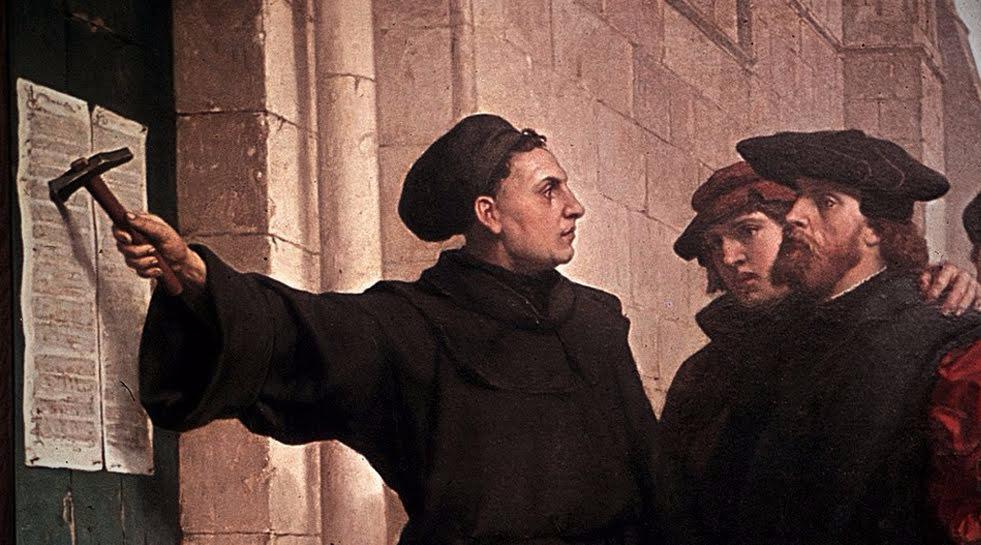
A Five Hundred Year Old Schism is Nothing to Celebrate
Today marks the 500th anniversary of the Protestant
Reformation; most of the people celebrating it would be considered blasphemous
heretics by Martin Luther, and those of us not celebrating it recognize that
schism is not a thing to rejoice over.
Let us pray that our descendants will not be observing a 600
year anniversary of the Protestant Reformation. Let us pray that we as the One
Holy Catholic and Apostolic Church will be reunited, for the sake of the world.
“I do not ask for
these only, but also for those who will believe in me through their word, that
they may all be one, just as you, Father, are in me, and I in you, that they
also may be in us, so that the world may believe that you have sent me. The
glory that you have given me I have given to them, that they may be one even as
we are one, I in them and you in me, that they may become perfectly one, so
that the world may know that you sent me and loved them even as you loved
me."--John 21:20-23
Thanks for reading all of the way through; I hope you like my blog! If so, I'd love for you to check out my Patreon page and support me as I go through seminary. Oh? You don't know I'm in seminary? Well, I am! Yeah, if you wish you can check out my article on that, here. Be sure to check out my Facebook page, too!
Oh! And I also run a podcast with my atheist friend, Xrys! It's called The Religious Nut and Hellbound Sinner Podcast, and we have a fun time discussing all sorts of topics: religion, politics, science, philosophy, movies, etc. Check out our Facebook page on that, as well!
Tuesday, October 24, 2017
Response to Quad-Cities Anglican Radio on their Interview with Fr. Mark Rowe
One of my favorite podcasts is Quad Cities Anglican Radio. I
actually happened upon it by chance; the name does not conjure up any sort of
thoughts of Anglo-Catholicism, and there are plenty of Anglican podcasts out there already for me to listen to. So I kept myself subscribed to them, and
more or less forgot they existed.
However, one day I looked at the names of their episodes,
and found their topics to be interesting. After giving an episode a try, I was
amazed to see how the hosts, both priests, were apparently very strong
Anglo-Catholics. They quickly became one of my favorite podcasts.
The ACNA (Anglican Church in North America), which is what both they and I are currently under, recently
came out with a statement concerning the ordination of women to the priesthood.
Traditional Anglicans, myself included, reject the ordination of women to the
priesthood (yes, it’s a controversial topic, and this article is not aimed at
defending the historic position; I do plan on writing an article in the future
on that subject). Unfortunately, the ACNA has some bishops who “ordain” women
to the priesthood, and the statement released recently stated, in essence, that
that practice will not change for now.
This is an unfortunate development within Anglicanism, and
many of us are deeply upset about our bishops’ current position on the matter.
So Quad-Cities Anglican has been doing a sort of tour of other catholic bodies
of the Faith, seemingly (and this is perhaps reading too much into their actions)
to hint that they and others are seriously looking at different jurisdictions.
Do I blame them? No, not at all. I don’t even think they’re
doing anything particularly wrong. They first looked at what’s known as the
Continuing Anglican churches, which just had a joint synod (that’s a very
exciting development, too). As well, they recently visited a ROCOR (RussianOrthodox Church Outside of Russia) Western Rite conference, and spoke to some
former Anglicans there.
This is where I started to find problems in what they were
doing. No, no; it’s not wrong to look at becoming Eastern Orthodox. Not
necessarily, at least (more on that, later). I sympathize with their
frustration with the ACNA. I truly do.
My problem is particularly in their first episode at the
conference, the one with Fr. Mark Rowe. Fr. Mark, a former Anglican (part of
the very Anglo-Catholic and conservative Continuing Anglicans; he also was
Roman Catholic before that…), joined the Orthodox Church after years of
searching. One of the pivotal points for him was visiting an Orthodox
monastery, in which he was asked four questions by a monk there.
The questions were—well, we’ll get to that in a moment.
They’re, bluntly put, silly. The responses (or lack thereof) were what greatly
frustrated me; both from Fr. Mark Rowe when he was Anglican and first receiving
these questions, and the two Anglican priests interviewing him.
I want to stress that I consider the Orthodox--both Eastern and Oriental--to be part of the One, Holy, Catholic, and Apostolic Church. I consider them full brothers and sisters in Christ. Unfortunately, they do not extend that same thought to Anglicanism (though there are historical exceptions). My problem is not that someone may want to join Orthodoxy, but rather that one is claiming that there is not Catholicity in Anglicanism, whatsoever. Furthermore, the responses to the following questions are, as indicated before, lackluster at best.
First Question: “Is
your church (currently) producing Saints?”
Response from the
Anglican Priests:
No canonized saints being currently produced. They agree
with Fr. Mark Rowe that, “The only answer is ‘no’.”
My Response:
What an insult to their own parish members. I’d be insulted
by that claim towards my parish; there are plenty of Saints there. A woman, the
week I listened to this, had given me money to help pay for my rent. She did it
without me asking, and she did it with no fanfare. One at my parish in Tennessee adopts children in his old age, and will just as soon give the shirt off his back to clothe someone naked. But they are not Saints?
As for canonicity, I find that a rather silly particular:
are we being asked for an official canonization process? Is there something
lacking in us not having the title “St.” preceding men like C.S. Lewis, who has
his own Anglican feast day? And what about Canon Andrew White? Did he not cross
the minds of our Anglican co-hosts as someone who most certainly is a Saint
being produced by our Communion? Is the Orthodox Church currently producing
Saints? Who? Seraphim Rose, the guy who apparently allowed “Gleb” HermanPodmoshensky to abuse young men at his monastery?
This question is rife with problems that, for the life of
me, I do not understand how even an unlearned Anglican could be troubled by. Frankly, the response they gave is both intellectually dishonest
and an insult to their flock.
Second Question: “If
you could do, liturgically, for the most part, that which you do now, but do it
within the Church that unequivocally is the Church founded by Christ, why would
you not do it?”
Response from the
Anglican Priests:
“I have no retort to that one.”
“I have no retort.”
To be fair, later, one of the priests defends Anglicanism in
this one; what I respond with in my first paragraph is also what he says (he
places it as a hypothetical; that one “might” argue such-and-such, distancing himself
from the argument). He then “balances” that with claiming that we aren’t
recognized by any of the five Patriarchates.
My Response:
The question presupposes that I am not part of the Church
founded by Christ already, or at least am unsure that I am. Except that I am
sure that I am; as sure as the Eastern Orthodox are.
We aren’t recognized by any of the five Patriarchates, but
that’s easily chalked up to politics at play. I mean, that’s what 1054 itself
is largely about, yes? And the debates between Oriental Orthodoxy and Eastern
Orthodoxy are, themselves, due to mistakes and misunderstandings. As well, I
would argue that Canterbury is certainly a Patriarchate—and if you are going to
raise the heresy that is currently going on in the Church of England, I’m going
to simply point to one of the past Patriarchs of Constantinople, the
arch-heretic Nestorius, and many others, in response.
Third Question: “Why
would you even take a chance on risking your salvation?”
A defense of Anglo-Catholicism was given, with an admission
that there is a “fly in the ointment” in the larger Anglican Communion.
My Response:
Yes, there is the "fly in the ointment" of women being "ordained" into the priesthood. There is, of course, also the greater problem of liberalism in the Anglican Communion in general. But in the 300's we had the Church Catholic literally taken over almost entirely by Arians--people who deny the full Deity of Christ. That was, interestingly enough, pushed by Eastern Bishops. We also had Nestorianism, again pushed not only by Eastern Bishops but literally named after the Patriarch of Constantinople. Later we had Monophysitism pushed by Eastern Bishops. Then Monothelitism pushed by Eastern Bishops. Seeing a trend, here? So the Eastern Orthodox have plenty of flies in their ointment's history.
Heresy gains major footholds sometimes; our job is to stand resolute against heresy, and speak the Truth in Love.
Fourth Question: “If
you were at liturgy in the Tomb of the Holy Sepulcher—the Tomb of your Savior,
Christ—could you take Communion?”
Response from the Anglican Priests: No.
My Response:
Why does that matter?
Seriously, if Mormons became militant and took over the Middle
East, and set up a church at the Tomb of the Holy Sepulcher, would that mean
that they are the one true Church? When Rome took over Jerusalem in the
Crusades, did that make them the one true Church? This argument depends upon
the geo-political reality of today, and doesn’t really demonstrate any
ecclesiastical ontology.
Also, you receive Communion; you don’t “take” it. Communion
is not yours for the taking.
These were the four questions the monk asked Fr. Mark Rowe, which ultimately helped lead him to reject his Holy Orders and become Orthodox. I don't find them convincing, on even the slightest level. There are reasons people are frustrated with the ACNA; I count myself among the frustrated. But these are not reasons to leave. This sort of thinking is one of the reasons I abandoned my journey towards Eastern Orthodoxy, and instead joined Anglicanism.
Thanks for reading all of the way through; I hope you like my blog! If so, I'd love for you to check out my Patreon page and support me as I go through seminary. Oh? You don't know I'm in seminary? Well, I am! Yeah, if you wish you can check out my article on that, here. Be sure to check out my Facebook page, too!
Oh! And I also run a podcast with my atheist friend, Xrys! It's called The Religious Nut and Hellbound Sinner Podcast, and we have a fun time discussing all sorts of topics: religion, politics, science, philosophy, movies, etc. Check out our Facebook page on that, as well!
Monday, October 9, 2017
Why Sacramental Theology is So Essential to the Christian Life
There was a man, Nicky, and woman, Suzie, who one day decided to get married. They invited their families and friends to the wedding, had their preacher marry them, and went off to their honeymoon in the Rockies for a week. When they returned, they bought a house together, got jobs, and lived in the same home for their entire lives. The couple lived long lives: both died in their nineties.
There's just one problem: during their entire lives, Nicky and Suzie never--and I mean never--were intimate. They never even held hands. Not a single time did they even accidentally physically bump into each other.
Oh, sure, they intellectually knew so much about the other: Suzie could tell you, from memory, every job that Nicky had ever had. Nicky could tell you what Suzie's favorite TV shows were. They both knew each others' favorite cereals. If you gave them each tests about the other person, they'd surely ace them.
Would...that be fully participating in marriage?
I think we would largely agree that something essential is lacking in that relationship.
But we have many Nicky and Suzie stories out there, today, in Christianity. We have "Christians", so-called, who aren't Baptized. We have people who have never received the Body and Blood of Christ in the Eucharist. We have people who think that the Christian life is all about an intellectual ascent, or maybe merely an inward repentance, and nothing else. I'm not talking about special cases, like the thief on the cross, or the person who's dying and who's just heard the Gospel for the first time. I'm speaking of people who, for years, actively do not participate in the Christian life via the Sacraments of Baptism and the Eucharist.
Baptism is our marriage into Christ: it is where we are physically enjoined to the death of Christ, so that we might rise with Him. That's in Romans 6, the entire chapter.
If Baptism is our marriage, then--and I don't mean anything funny by this--the Eucharist is sex.
1 Corinthians 10:16 seems to indicate as much in its usage of the word "koinonia"; it's meant to convey a most intimate connection. That's not necessarily sex, but I'm using it as an "if/then", and koinonia is certainly a very deep connection/participation/fellowship.
Not comfortable with that? We can use this instead: if Baptism is birth, then the Eucharist is feeding for nourishment.
However you want to look at it, Baptism and the Eucharist are important parts of the Christian Faith. Jesus claims that we have no life in us unless we "truly truly...eat [His] Flesh and drink [His] Blood". Back to 1 Corinthians 10:16, it asks rhetorically if Communion is not a participation in the Body and Blood of Christ; St. Paul also claims that we must be careful to discern the Body of Christ, or we partake to our own judgment (1 Corinthians 11:27-32).
Sacramental theology is the belief that we are actually, truly, connected to Christ in some mysterious way, through the Sacraments of Baptism and the Eucharist. That's what "Sacrament" means: mystery. Unlike much of modern American Christianity, it teaches that there is a tangible, incarnational element to our Faith that we can physically interact with.
Jesus didn't simply leave us with a book (well, He never did that anyway; let alone "simply" do that). Jesus left us with a cleansing and a meal. It was by eating that we fell in sin; how fitting that by eating, we are brought back into a most intimate fellowship with God.
Thanks for reading all of the way through; I hope you like my blog! If so, I'd love for you to check out my Patreon page and support me as I go through seminary. Oh? You don't know I'm in seminary? Well, I am! Yeah, if you wish you can check out my article on that, here. Be sure to check out my Facebook page, too!
Oh! And I also run a podcast with my atheist friend, Xrys! It's called The Religious Nut and Hellbound Sinner Podcast, and we have a fun time discussing all sorts of topics: religion, politics, science, philosophy, movies, etc. Check out our Facebook page on that, as well!
Thursday, October 5, 2017
Long Awaited Update from the New Seminarian
Hey, all! I'm in seminary now!
So, this entire year has been rather eventful: from my brother and his family becoming Roman Catholic (former Baptists), to me starting a relationship with a girl (some girl...likes me? I know; I'm amazed, too!), to starting a new podcast, to a car crash, to lots of traveling, and finally, to applying and now attending a seminary, I've been through quite a bit!
What seminary am I at? Well, Trinity School for Ministry, of course! It's an Anglican seminary, with a strong Evangelical bent to it. You might think that a cranky Anglo-Catholic like myself would want to stay away from an institution with such a push...and you'd be right, probably. While I'm Anglo-Catholic, I'm not (always) cranky.
But sincerely, I don't want to be unbalanced. There is this understanding of Anglicanism where we are "three streams" of Christianity: Liturgical, Evangelical, and Charismatic. I don't want to segment myself into simply one of those streams; I want to embrace the fullness of the Faith. Catholicism, properly understood, embraces the fullness of the Faith, and I want to do likewise.
Trinity is an amazing seminary, with excellent professors and a welcoming, loving spirit. The education has, so far, been top-notch. As well, there is a Lutheran track for my Lutheran friends! What I love best is how the seminary is equipping us for ministry, rather than simply filling empty heads with knowledge (mine's more emptier-er than others).
Please keep me in prayer, as finances are tough during this time.
That's where you guys come in.
I've set up a Patreon page in order to help with the finances for my time in seminary. I'm going for an M.Div, so that means I'll be here for three years. As of now, I'm doing full time work and full time school; while I am so far managing that balance as much as I can, it is incredibly stressful and does not allow me to fully immerse myself in my studies. Donating to my Patreon will help me, immensely, in being able to devote my time to my academic studies.
Thanks for sticking with me while I continue this crazy ride through life, continuing to follow my Lord and Savior, Jesus Christ, however imperfectly that is done. :)
So, this entire year has been rather eventful: from my brother and his family becoming Roman Catholic (former Baptists), to me starting a relationship with a girl (some girl...likes me? I know; I'm amazed, too!), to starting a new podcast, to a car crash, to lots of traveling, and finally, to applying and now attending a seminary, I've been through quite a bit!
What seminary am I at? Well, Trinity School for Ministry, of course! It's an Anglican seminary, with a strong Evangelical bent to it. You might think that a cranky Anglo-Catholic like myself would want to stay away from an institution with such a push...and you'd be right, probably. While I'm Anglo-Catholic, I'm not (always) cranky.
But sincerely, I don't want to be unbalanced. There is this understanding of Anglicanism where we are "three streams" of Christianity: Liturgical, Evangelical, and Charismatic. I don't want to segment myself into simply one of those streams; I want to embrace the fullness of the Faith. Catholicism, properly understood, embraces the fullness of the Faith, and I want to do likewise.
Trinity is an amazing seminary, with excellent professors and a welcoming, loving spirit. The education has, so far, been top-notch. As well, there is a Lutheran track for my Lutheran friends! What I love best is how the seminary is equipping us for ministry, rather than simply filling empty heads with knowledge (mine's more emptier-er than others).
Please keep me in prayer, as finances are tough during this time.
That's where you guys come in.
I've set up a Patreon page in order to help with the finances for my time in seminary. I'm going for an M.Div, so that means I'll be here for three years. As of now, I'm doing full time work and full time school; while I am so far managing that balance as much as I can, it is incredibly stressful and does not allow me to fully immerse myself in my studies. Donating to my Patreon will help me, immensely, in being able to devote my time to my academic studies.
Thanks for sticking with me while I continue this crazy ride through life, continuing to follow my Lord and Savior, Jesus Christ, however imperfectly that is done. :)
Thursday, January 12, 2017
For the Wages of Sin is Death, Not Torture: Why I Hold to Annihilationism (Part 2: Scripture)
Sorry; this was finished much later than I was hoping. I partly forgot to finish it and partly was busy with school and the Christmas Season.
In the last article on this subject, we talked about the reasons, nature, and goals for punishment. I want to, in this article, look at specific passages talking about the nature and goals of punishment. This is Part 2 in my explanation and defense of Annihilationism (Part 1 can be found here).
Before we start, I want you to do something for me. I want you to challenge yourself on a few presuppositions:
Find me a verse stating that souls are inherently immortal.
We come to Scripture, many of us, with the Platonic error of assuming that souls are inherently immortal, and therefore either can't die or by default will never die, wicked or righteous. What verses claim that?
Find me a verse stating that the punishment for sin is eternal conscious torment.
In the last article on this subject, we talked about the reasons, nature, and goals for punishment. I want to, in this article, look at specific passages talking about the nature and goals of punishment. This is Part 2 in my explanation and defense of Annihilationism (Part 1 can be found here).
Before we start, I want you to do something for me. I want you to challenge yourself on a few presuppositions:
Find me a verse stating that souls are inherently immortal.
We come to Scripture, many of us, with the Platonic error of assuming that souls are inherently immortal, and therefore either can't die or by default will never die, wicked or righteous. What verses claim that?
Find me a verse stating that the punishment for sin is eternal conscious torment.
Aha! You might say. You probably came up with Revelation 20:10 or Matthew 25:46. Eh...just hold on to those verses; they'll be dealt with soon enough.
Also, I want to assure you that Annihilationism is NOT the following:
It is NOT the claim that there is no punishment for sins.
It is NOT the claim that the punishment for sins is temporary.
It is NOT the claim that there is no hell.
There; are we good? Okay, now, onward!
The Nature of the Punishment: Death, not Torture
Romans 6:23
"For the wages of sin is death, but the gift of God is eternal life, through Jesus Christ our Lord."
The wages of sin is...death? Not torment? But can't death simply mean "separation from God" or something?
I mean, it can and, I would argue, does have that definition. The problem is that that definition would still point to annihilation. If God is the Source of life, and you are separated from God...you are separated from the Source of life. No one is truly and fully separated from the Source of life until the Judgment. Even the reprobate today receive the grace of God: "The rain falls on the just and the unjust."
Matthew 10:28
"And do not fear those who kill the body but cannot kill the soul; rather fear him who can destroy both soul and body in hell."
This passage speaks so clearly to what death is in the context of its relationship to hell. Here, what Jesus says is that what happens to the body at death by the hand of man (destruction, cessation of life in the body, but not cessation of life in the soul), happens to both soul and body in hell (destruction, cessation of life in both body and soul).
2 Thessalonians 1:9
"They shall suffer the punishment of eternal destruction and exclusion from the presence of the Lord and from the glory of his might."
The wicked suffer the punishment of "eternal destruction", and they will no longer be in the presence of the Lord or the glory of his might. The destruction lasts forever, unlike the 1st death. This is compounded by the fact that they will no longer be in the presence of the Lord. The Lord, Who is, of course, omni-present.
Matthew 25:46
"And they will go away into eternal punishment, but the righteous into eternal life."
After spending quite a few verses detailing how the righteous and wicked will be judged, Jesus states that the wicked will receive eternal punishment, but (and the word "but" is essential, here!) the righteous will receive eternal life."
"But Barely Protestant! Jesus just stated that the wicked will receive 'eternal punishment', right? Surely, that means that the wicked are tormented for all eternity!"
Nope. At least, not necessarily. And when you define the punishment for sins as Scripture does, it really doesn't make sense to claim that the punishment is eternal torment.
A man who is sentenced to be killed for his crimes, what is his punishment? Death. Death is his punishment.
"But Barely Protestant! It says 'eternal punishment'! Death isn't eternal! It's, well, momentary, and...well, okay, it actually is eternal, I guess, but, well, it doesn't hurt eternally! So there!"
The first death isn't eternal, sure. After all, we all get Resurrected. However, the righteous and wicked are Resurrected to be judged, and the punishment of the wicked is known as "the second death". In addition to this, the Scriptures repeatedly state (as has already been seen) that the punishment is death. If the first death is not eternal, and the punishment is known as "the second death", then it makes sense that Scripture would call this "eternal punishment": the punishment (death!) is eternal! This isn't contrived, but a consistent reading of what Scripture repeatedly says about the punishment for sin.
Matthew 25:46
"And they will go away into eternal punishment, but the righteous into eternal life."
After spending quite a few verses detailing how the righteous and wicked will be judged, Jesus states that the wicked will receive eternal punishment, but (and the word "but" is essential, here!) the righteous will receive eternal life."
"But Barely Protestant! Jesus just stated that the wicked will receive 'eternal punishment', right? Surely, that means that the wicked are tormented for all eternity!"
Nope. At least, not necessarily. And when you define the punishment for sins as Scripture does, it really doesn't make sense to claim that the punishment is eternal torment.
A man who is sentenced to be killed for his crimes, what is his punishment? Death. Death is his punishment.
"But Barely Protestant! It says 'eternal punishment'! Death isn't eternal! It's, well, momentary, and...well, okay, it actually is eternal, I guess, but, well, it doesn't hurt eternally! So there!"
The first death isn't eternal, sure. After all, we all get Resurrected. However, the righteous and wicked are Resurrected to be judged, and the punishment of the wicked is known as "the second death". In addition to this, the Scriptures repeatedly state (as has already been seen) that the punishment is death. If the first death is not eternal, and the punishment is known as "the second death", then it makes sense that Scripture would call this "eternal punishment": the punishment (death!) is eternal! This isn't contrived, but a consistent reading of what Scripture repeatedly says about the punishment for sin.
I could go on and on with these passages, but I want to finish this article up some time this century, so I will instead give references to a few more along these lines:
(This list is taken from Preston Sprinkle's article on the subject. Preston Sprinkle co-wrote with Francis Chan Erasing Hell, a book responding in part to Rob Bell's Love Wins; after co-writing that book, Preston Sprinkle now leans heavily towards the concept of annhilationism, though he is not yet thoroughly convinced. As well, I and many annihilationists would differ from him on certain claims, even in the above-mentioned article. Here is the first part of a two-part interview Preston Sprinkle did with Rethinking Hell on the subject; it's a very good listen!)
Verses talking about the punishment being "destruction" or "perishing":
Matthew 7:13, John 3:16, John 17:12, Acts 8:20, Romans 9:22-23 (hey, Calvinists! it's in your favorite chapter!), Philippians 1:28, Philippians 3:19, 2 Thessalonians 2:3, 1 Timothy 6:9, Hebrews 10:39, 2 Peter 2:1, 1 Thessalonians 5:3.
Verses talking about the punishment being "death":
Romans 1:32, Romans 6:21, Romans 7:5, Romans 8:6, 1 Corinthians 15:21-22 and 56, 2 Corinthians 2:16, 2 Corinthians 7:10, James 1:15, James 5:20, 1 John 5:16, Revelation 2:11, Revelation 20:6 and 14, Revelation 21:8.
Verses talking about the punishment being the "end":
Romans 6:21-22, 2 Corinthians 11:15, Philippians 3:19, 1 Peter 4:1.
Verses talking about the punishment being "disintegration/corruption":
Galatians 6:8, 2 Peter 1:4, 2 Peter 2:12.
This barely scratches the surface; for instance, we've not even hit on the Old Testament passages! But I hope these are enough to at least help you rethink your understanding of what Scripture says about the nature of final punishment.
The Goals of God's Judgment
The way Scripture talks about creation after the Judgment leaves me with only two options: Annihilationism or Universalism. Why? Well, let's look at what Scripture says:
1 Corinthians 15:24-28
Here, we see a future in which all of creation is under the rule of Christ, Who gives His Kingdom to the Father. It explicitly states that "the last enemy to be destroyed is death". Even death itself will be no more, after all of the wicked are destroyed.
Colossians 1:19-20
We see God reconciling ALL things to Himself through Christ. This paints a picture, along with 1 Corinthians 15, of there being a time where there is no more death or rebellion against God. Now, in the traditional understanding, is there still rebellion? Of course there is. Those in hell would be still rebelling against God, would they not?
Isaiah 66:22-24
Here, we see a depiction of the result of the final judgment, after a poetic passage proclaiming that "From new moon to new moon, and from Sabbath to Sabbath, all flesh shall come to worship before Me, says the LORD." All flesh shall worship the Lord, and the dead bodies of the wicked will be eaten by worms and burned in unquenchable fire. Notice that the people, the wicked, are dead. This isn't talking about torment, but rather their dead bodies; their carcasses. The worm "dies not" until it has completely eaten the flesh, and the fire is "unquenched", meaning it will utterly destroy what remains, without interruption.
Objections:
"But," some of you might say, "what about the Rich Man and Lazarus? What about Revelation 20:10?"
The parable (or true account, if you wish: it doesn't change this question either way) of the Rich Man and Lazarus (Luke 12:19-31) is not about hell. Specifically, it's about the intermediate state, known as hades. Whether this depiction is to be taken as a factual account or a metaphor, the point is that this is depicting what happens before the Judgment. This is evidenced by the fact that the Rich Man asks Abraham to let Lazarus witness to his brothers, who are still alive.
As for Revelation 20:10, the Book of Revelation itself is a very confusing read. First, let me ask this: do you believe that there will be (or there was) a literal seven-headed, ten-horned beast with a vampiric prostitute riding its back?
The way Scripture talks about creation after the Judgment leaves me with only two options: Annihilationism or Universalism. Why? Well, let's look at what Scripture says:
1 Corinthians 15:24-28
Here, we see a future in which all of creation is under the rule of Christ, Who gives His Kingdom to the Father. It explicitly states that "the last enemy to be destroyed is death". Even death itself will be no more, after all of the wicked are destroyed.
Colossians 1:19-20
We see God reconciling ALL things to Himself through Christ. This paints a picture, along with 1 Corinthians 15, of there being a time where there is no more death or rebellion against God. Now, in the traditional understanding, is there still rebellion? Of course there is. Those in hell would be still rebelling against God, would they not?
Isaiah 66:22-24
Here, we see a depiction of the result of the final judgment, after a poetic passage proclaiming that "From new moon to new moon, and from Sabbath to Sabbath, all flesh shall come to worship before Me, says the LORD." All flesh shall worship the Lord, and the dead bodies of the wicked will be eaten by worms and burned in unquenchable fire. Notice that the people, the wicked, are dead. This isn't talking about torment, but rather their dead bodies; their carcasses. The worm "dies not" until it has completely eaten the flesh, and the fire is "unquenched", meaning it will utterly destroy what remains, without interruption.
Objections:
"But," some of you might say, "what about the Rich Man and Lazarus? What about Revelation 20:10?"
The parable (or true account, if you wish: it doesn't change this question either way) of the Rich Man and Lazarus (Luke 12:19-31) is not about hell. Specifically, it's about the intermediate state, known as hades. Whether this depiction is to be taken as a factual account or a metaphor, the point is that this is depicting what happens before the Judgment. This is evidenced by the fact that the Rich Man asks Abraham to let Lazarus witness to his brothers, who are still alive.
As for Revelation 20:10, the Book of Revelation itself is a very confusing read. First, let me ask this: do you believe that there will be (or there was) a literal seven-headed, ten-horned beast with a vampiric prostitute riding its back?
I'm guessing not.
The thing about Revelation is that it gives a LOT of imagery that John sees, and writes down. Sometimes the imagery is interpreted by an Angel or revealed in the book itself. For the imagery of eternal torment in Revelation 20:10, there is an interpretation of it given. In verse 14, we see an interpretation of the "Lake of Fire":
"Then Death and Hades were thrown into the Lake of Fire. This is the Second Death, the Lake of fire;"
As well, the imagery of the Beast being thrown into the Lake of Fire is, in part, taken from similar imagery in the Book of Daniel. In Daniel 7, we see the Fourth Beast being thrown into fire is interpreted by the angel in verse 26 as the destruction of the kingdom it represents. Christian exegetes largely consider this to be the same beast as in Revelation, the one thrown into the Lake of Fire. If these images both depict the same event, it seems to be undeniable that the imagery in Revelation 20 is meant to be interpreted as death and destruction. And remember, that's what Revelation 20:14 seems to state, as well!
Apocalyptic imagery is almost always weird. We need to take the Biblical interpretation of the imagery at face-value, not the imagery itself. So don't take the imagery in which torment is depicted as more literal than the angelic interpretation in Daniel 7:26 and the explanation in Revelation 20:14.
Conclusion:
Are there other objections? Probably, though, none that I can think of right now. At least, none that are Biblical. If you think of any, comment below and let me know. I'll try to answer them. My next article in this particular series will talk about the Early Church and what they thought on the subject. You may be surprised with that one, as well!
Check out Rethinking Hell, a great website of conservative Christians from various denominations who defend this concept of hell. As well, they have a podcast and YouTube channel. They're a really great source on this subject. Enjoy!
Thanks for reading all of the way through; I hope you like my blog! If so, I'd love for you to check out my Patreon page and support me as I go through seminary. Oh? You don't know I'm in seminary? Well, I am! Yeah, if you wish you can check out my article on that, here. Be sure to check out my Facebook page, too!
Oh! And I also run a podcast with my atheist friend, Xrys! It's called The Religious Nut and Hellbound Sinner Podcast, and we have a fun time discussing all sorts of topics: religion, politics, science, philosophy, movies, etc. Check out our Facebook page on that, as well!
Subscribe to:
Posts (Atom)